

Keywords
end-stage renal disease
hemodialysis
patient education
self-care
vascular access
How to Cite




Abstract
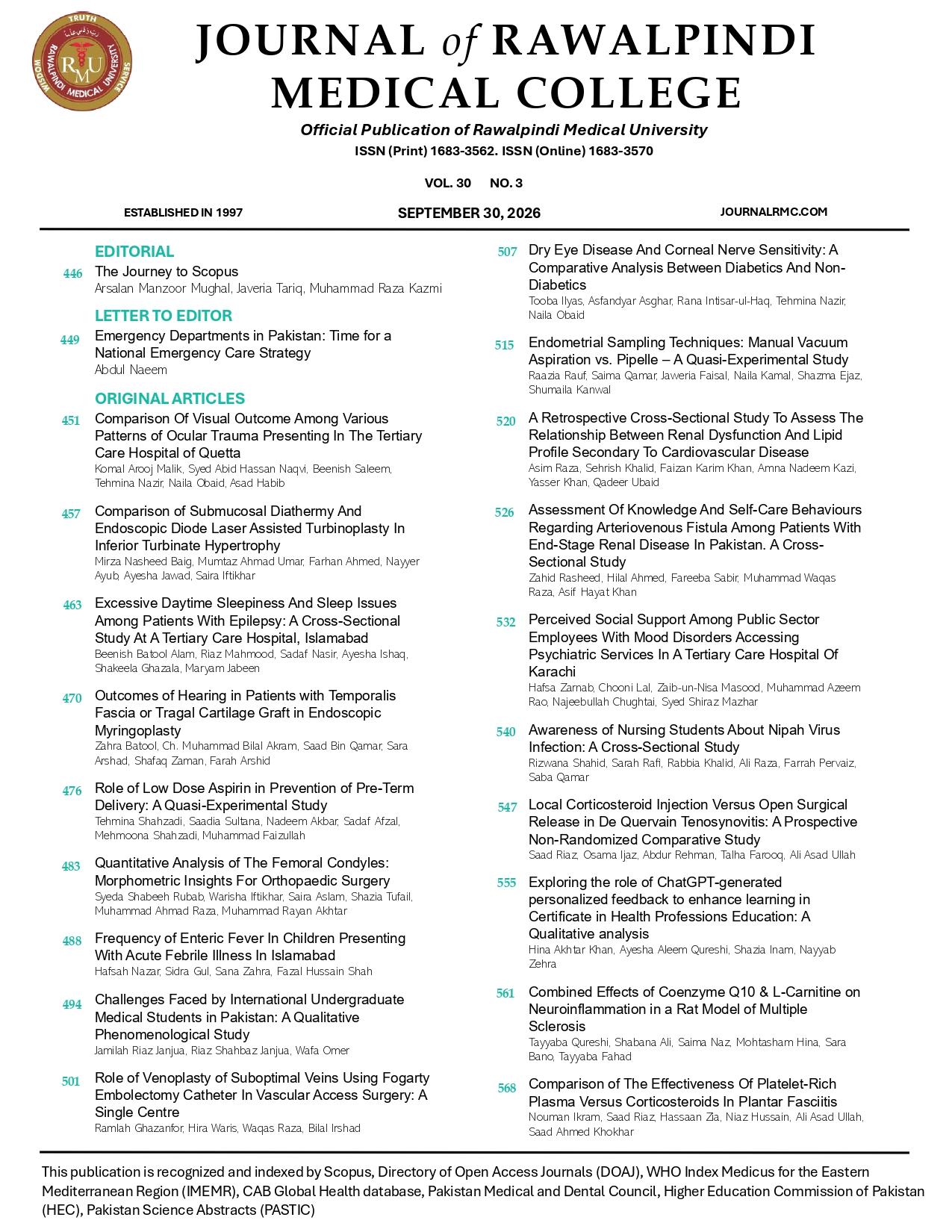
Objective: To evaluate ESRD patients' awareness and understanding of self-care for AVF maintenance and explore the association, such as demographic and clinic characteristics that are associated with awareness and motivation for caring for AVF.
Methods: This descriptive cross- sectional study was conducted over a period of six months in tertiary care hospitals affiliated with Rawalpindi Medical University, Pakistan. Sixty adult patients with ESRD receiving regular haemodialysis were enrolled using a non-probability consecutive sampling method. A validated structured questionnaire was used to collect data on demographic and clinical characteristics, as well as information related to AVF self-care knowledge and practice. Statistical analysis: All statistical analyses were performed using SPSS version 27. Descriptive statistics were used to summarise participant characteristics, and Chi-square or Fisher’s exact test was used to ascertain demographic relationships with awareness of AVF self-care. Crude odds ratios (ORs) with 95% confidence intervals (CIs) were reported, and p<0.05 was considered statistically significant.
Results: The mean age of the participants was 50.2 ± 13.6 years, and sex distribution was equal (50% male and 50% female). The most common comorbidities were hypertension (66.7%) and diabetes mellitus (55%). Ninety per cent perceived AVF to be superior to catheters, but only 16.7% examined for vascular thrill, and 38.3% practiced adequate hygiene. Knowledge on avoidance of sleeping on the AVF limb (56.7%), heavy lifting (45 %), tight clothing (35 %), and unnecessary needling puncture pricks (30%) was insufficient. This awareness and motivation were significantly higher in females, those with higher education levels, and patients with diabetes (p < 0.05). Patients treated two times per week had more compliant behaviour with respect to AVF care than those treated three times weekly (p = 0.049).
Conclusion: While most patients with ESRD are aware of the benefits of AVF, significant gaps in self-care activities remain. Gender, education, co-morbidity, and dialysis number were significant predictors of the aware and motivated status. Structured innovation of patient education and counselling mechanisms is necessary to improve AVF self-care procedures, minimise access-related complications, and enhance haemodialysis outcomes.
Keywords: Arteriovenous fistula, awareness, end-stage renal disease, hemodialysis, patient education, self-care, vascular access.
References
Dev S, Luitel P, Sah B, Yadav BK, Dev B, Thapaliya I, et al. Knowledge, attitude, and practice on arteriovenous fistula care among end-stage kidney disease patients receiving maintenance hemodialysis: a single-center, prospective cohort study in Nepal. Health Sci Rep. 2025;8(5). https://doi.org/10.1002/hsr2.70823.
Firdaus AJ, Kurnianingsih N. Pivotal role of duplex ultrasonography on arteriovenous fistula for hemodialysis access. Jurnal Klinik dan Riset Kesehatan. 2024;3(3):191-203. https://doi.org/10.11594/jk-risk.03.3.6.
Fielding C. Commentary: the relationship between self-care behaviours regarding arteriovenous fistula and the fear of fistula failure in individuals receiving haemodialysis treatment. J Res Nurs. 2024;29(4-5):399-400. https://doi.org/10.1177/17449871241264025.
Köse E, Vural Doğru B, Gün M. The effects of arteriovenous fistula knowledge and self-care behaviors of hemodialysis patients on arteriovenous fistula complications. Arch Health Sci Res. 2021;8(2):110-116. https://doi.org/10.5152/ArcHealthSciRes.2021.20100.
Villanueva AD. A systematic review of patient education strategies for arteriovenous fistula care in hemodialysis patients. GSC Biol Pharm Sci. 2024;29(2):92-95. https://doi.org/10.30574/gscbps.2024.29.2.0376.
Fareed L, Saeed AA, Ahmed YA. Pain and anxiety during AV fistula cannulation among hemodialysis patients. Biol Clin Sci Res J. 2025;6(4):27-30. https://doi.org/10.54112/bcsrj.v6i4.1647.
Ghazi IN, Mohammed WK. Application of self-care behaviour scale for arterio venous fistula among hemodialysis patients. Pak J Med Health Sci. 2022;16(5):786-789. https://doi.org/10.53350/pjmhs22165786.
Borzou SR, Rasoli M, Khalili Z, Tapak L. Comparison of group discussion and teach back selfcare education effects on knowledge, attitude, and performance of hemodialysis patients. Nephro-Urol Mon. 2020;12(3). https://doi.org/10.5812/numonthly.105938.
Mahmood SN, Hameed N, Naveed HK, Qureshi MFH, Imtiaz SH, Rajput AS. Risk factors affecting mortality in Asian hemodialysis patients: a 15-year study from Pakistan. Cureus. 2025;17(1). https://doi.org/10.7759/cureus.77328.
Gaffer EL, Ali HAK, Ibrahim RA. Effect of teaching guidelines on uremic patients regarding arteriovenous fistula occlusion. J Nurs Sci Benha Univ. 2021;2(1):109-123. https://doi.org/10.21608/jnsbu.2021.159646.
Pessoa NRC, Lima LHSS, Santos GA, Frazão CMFQ, Sousa CN, Ramos VP. Self-care actions for the maintenance of the arteriovenous fistula: an integrative review. Int J Nurs Sci. 2020;7(3):369-377. https://doi.org/10.1016/j.ijnss.2020.06.007.
Widyastuti CS, Dinarti LK, Aulawi K, Lazuardi L. Effectiveness of mHealth on self-care profile and blood pressure among patients with hypertension in Indonesia: a single-blind randomized controlled trial. Belitung Nurs J. 2025;11(3):294-304. https://doi.org/10.33546/bnj.3760.
Wang R, Zhou C, Wu Y, Sun M, Yang L, Ye X, et al. Patient empowerment and self-management behaviour of chronic disease patients: a moderated mediation model of self-efficacy and health locus of control. J Adv Nurs. 2022;78(4):1055-1065. https://doi.org/10.1111/jan.15077.
Pitanupong J, Janmanee S. End-of-life care preferences among cancer patients in Southern Thailand: a university hospital-based cross-sectional survey. BMC Palliat Care. 2021;20(1):90. https://doi.org/10.1186/s12904-021-00775-6.

This work is licensed under a Creative Commons Attribution-ShareAlike 4.0 International License.
Copyright (c) 2026 Dr. Zahid Rasheed, Dr. Hilal Ahmed, Dr. Fabeera Sabir, Muhammad Waqas Raza, Asif Hayat Khan